
Farmhouse holiday cottages in a tranquil rural hideaway Ceredigion, West Wales.
Llansteffan Castle
50 Mins from our holiday cottages
28 Miles from our holiday cottages
Dog Friendly
Llansteffan Castle, Llansteffan, Carmarthenshire
SA33 5LP (Sat Nav)
Dog Friendly Information
Dogs are welcome, get them to pull you up the hill!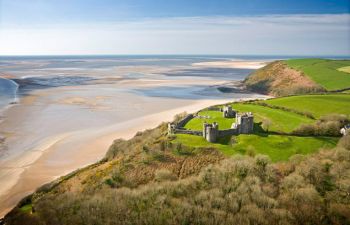

Llansteffan Castle
To reach the castle, there two paths from the main car park, a steep walk but the views from the top are worth it.
Open all year 10.00am - 4.00pm. Closed 24, 25, 26 December and 1 January
Under 16s must be accompanied by an adult Dogs on leads welcome No smoking
The interior of the castle is lawned but steep in several places. Care should be taken when accessing the upper levels to the main gatehouse
Llansteffan Castle was originated, by the Normans in the early 12th century conquerors of Britain.
To get an understanding of the castle's design, make a complete circuit around the grassy interior. Today it is mainly ruined and only a few buildings stand intact but the castle was once a building with great vitality and sophistication.
The castle's history was tumultuous, at times occupied by the Welsh, the Normans and the English. Nevertheless, the de Camvilles kept ownership of the castle despite Welsh attempts to the contrary they refortified the castle with stonework in 1192, and after the 1215 attack by the Welsh, the Norman overlords built the well-preserved Inner Gate and a round tower (the keep).
The views from the curtain wall are simply superb, and certainly would have allowed the garrison to spot any attackers approaching the castle.
After Llywelyn's last siege in 1257, the de Camvilles extended the defensive boundaries of their castle, and created what is now known as the Lower Ward. Although this area seems relatively open and vulnerable, it was actually surrounded with some very formidable structures: The Great Gatehouse, two impressive corner towers, a fighting platform (the East Bastion), the Great Hall, and more stalwart curtain walling
Llansteffan Castle's most remarkable building is the monumental Great Gatehouse, initiated in the late 13th century. It would have been an intimidating barrier against siege. It had two portcullises, heavy double-doors, murder holes, arrow slits, and guardrooms
During the very late 15th century, major modifications were made and effectively changed the gatehouse from a defensive stronghold to a grand residence, fit for a king.
Despite this for the next 200 years, Llansteffan Castle was neglected and became a ruin. By the 18th century, the structure had survived as a part of a private farm.
The 19th century wave of romanticism and antiquarian interest in castle ruins, Llansteffan was revitalized, for tourists.
Finally, in the 20th century, the castle was taken into care of CADW:Welsh Historic Monuments. ,
Share this article
Stay in the Mill
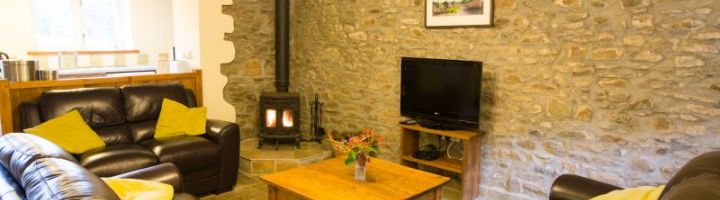
The Mill holiday cottage is a luxury barn conversion.
- Sleeps 6 in 3 bedrooms
- Private enclosed garden
- 2 bathrooms
- Wi-Fi Broadband
- Plus much more...
Stay in the Byre

The Byre holiday cottage is a single storey barn conversion.
- Sleeps 4 in 2 bedrooms
- Private enclosed garden
- No steps or stairs
- Wi-Fi Broadband
- Plus much more...
Dog Friendly Holiday Cottages

Stallion Valley has been designed to be properly dog friendly, and has a wide range of dog friendly facilties.
Stallion Valley
Holiday Cottages
Latest Blog Entries
- Sunny New Quay Tuesday, this week for a lunch & a stroll.
Friday 27th of February 2026 02:46 PM
- New Year guest comments
Sunday 11th of January 2026 10:51 AM
- Amber's 1st visit
Friday 18th of July 2025 04:36 PM
Contact Us
Cwm March Farmhouse Cottages
Llandysul
Ceredigion
SA44 4LR
07976 893092